

How Pharmaceutical Innovation Is Shaping the Future of Healthcare
October 7, 2026
Top Pharma Companies in India: How Leading Pharmaceutical Companies Drive Healthcare Innovation
October 12, 2026
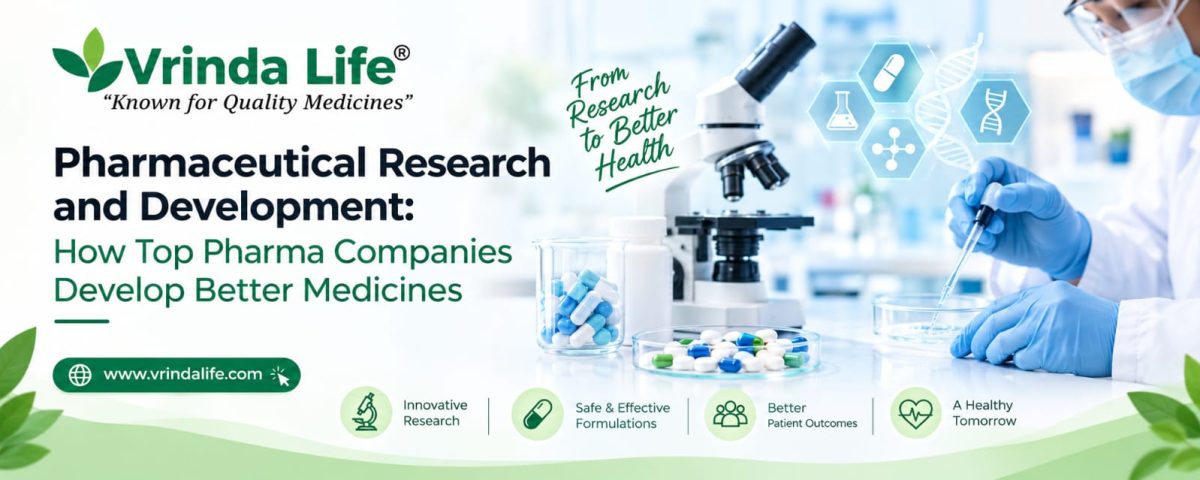
Pharmaceutical research is the foundation behind many of the medicines used in modern healthcare. From identifying promising molecules to testing safety, improving formulations, conducting clinical trials, and monitoring medicines after approval, drug development is a long and highly controlled process.
For pharmaceutical companies, success in research and development (R&D) is not simply about discovering a new compound. It is about converting scientific knowledge into medicines that are safe, effective, stable, affordable, and practical for patients and healthcare professionals.
Today, leading pharmaceutical companies are combining scientific expertise with advanced technologies, data-driven research, improved manufacturing capabilities, and stronger regulatory practices. For healthcare professionals, medical distributors, pharmacists, and entrepreneurs, understanding this process provides valuable insight into how modern medicines reach the market.
What Is Pharmaceutical Research and Development?
Pharmaceutical research and development refers to the scientific and technical activities involved in discovering, developing, testing, and improving medicines.
The process can include:
- Identifying potential drug candidates
- Laboratory and preclinical research
- Formulation and dosage-form development
- Pharmacological and toxicological studies
- Clinical trials
- Manufacturing process development
- Regulatory submissions
- Quality testing and validation
- Post-marketing safety monitoring
The process is designed to answer two fundamental questions: Does the medicine work, and is it sufficiently safe for its intended use?
For example, the U.S. FDA describes drug development as a progression from discovery and development through preclinical research, clinical research, regulatory review, and post-market safety monitoring.
Why Pharmaceutical R&D Matters
Effective pharmaceutical research can address unmet medical needs, improve existing treatments, and make therapies easier to administer.
Innovation does not always mean creating an entirely new drug. R&D can also lead to:
- Better drug-delivery systems
- Improved stability and shelf life
- More convenient dosage forms
- Reduced dosing frequency
- Improved bioavailability
- Complex generics and biosimilars
- New combinations of established medicines
- Better patient adherence
This distinction is important for the pharmaceutical industry. A medicine can become more useful to patients through meaningful improvements in formulation, delivery, quality, or accessibility even when the underlying active ingredient is not new.
Key Stages of Pharmaceutical Research
1. Drug Discovery
The journey typically begins with identifying a biological target associated with a disease and searching for molecules or biological candidates that may influence that target.
Researchers may use laboratory experiments, molecular biology, medicinal chemistry, computational techniques, and increasingly sophisticated data-analysis tools.
At this stage, many potential candidates may be investigated, but only a small proportion are likely to progress into further development.
2. Preclinical Research
Before an investigational medicine is administered to humans, researchers conduct laboratory and, where appropriate, animal studies to evaluate pharmacological activity and potential safety risks.
Preclinical work can examine areas such as toxicity, pharmacokinetics, metabolism, and how the candidate behaves in biological systems.
The purpose is not to prove that a medicine is completely risk-free. Instead, the research helps determine whether there is sufficient evidence and justification to move into carefully controlled human studies.
3. Formulation Development
A promising active ingredient still needs to become a usable medicine.
Scientists and formulation specialists determine how the active pharmaceutical ingredient can be delivered effectively. Depending on the product, this may involve tablets, capsules, injections, liquids, topical preparations, modified-release formulations, or other dosage forms.
Researchers consider factors such as:
- Dose
- Stability
- Solubility
- Absorption
- Compatibility of ingredients
- Manufacturing feasibility
- Packaging
- Storage conditions
This stage demonstrates why pharmaceutical R&D involves much more than laboratory discovery.
4. Clinical Research
Once sufficient preclinical evidence has been generated and regulatory requirements are met, the medicine can enter clinical research.
Clinical development generally progresses through different phases. Phase 1 primarily focuses on safety, tolerability, pharmacokinetics, and appropriate dosing. Phase 2 investigates preliminary effectiveness while continuing safety evaluation. Phase 3 involves larger studies designed to generate more comprehensive evidence about effectiveness and safety.
Clinical research must also follow appropriate scientific and ethical standards, with safeguards designed to protect participants.
In India, the Central Drugs Standard Control Organization (CDSCO) oversees important aspects of new-drug and clinical-trial regulation under the New Drugs and Clinical Trials Rules, 2019. Its Investigational New Drug division handles applications related to clinical trials and investigational medicines.
How Top Pharma Companies Improve Medicines
Leading pharmaceutical companies increasingly focus on several areas to strengthen their R&D capabilities.
Using Data and Artificial Intelligence
Advanced analytics and artificial intelligence can support areas such as target identification, molecule screening, clinical-trial planning, and data analysis.
These technologies do not eliminate the need for scientists or clinical expertise. Instead, they can help research teams process large amounts of information and identify potentially useful patterns more efficiently.
Developing Complex Generics and Biosimilars
Pharmaceutical innovation is also expanding into complex generics and biosimilars.
These products can require sophisticated scientific, analytical, formulation, and manufacturing capabilities. India’s policy environment increasingly recognises these areas as important components of a more innovation-driven pharmaceutical ecosystem. The government’s PRIP scheme identifies complex generics and biosimilars among its priority areas
Strengthening Industry-Academia Collaboration
Modern pharmaceutical research rarely happens in isolation. Pharmaceutical companies can collaborate with universities, research institutes, hospitals, biotechnology organisations, and technology companies.
India’s Promotion of Research and Innovation in Pharma MedTech Sector (PRIP) scheme specifically aims to encourage industry-academia collaboration and accelerate the transition from research to commercialisation.
Improving Manufacturing and Quality
A promising medicine is only valuable when it can be manufactured consistently.
Therefore, pharmaceutical R&D increasingly connects with process development, analytical testing, quality assurance, validation, and manufacturing science.
Regulatory review also considers manufacturing controls and whether they are adequate to maintain a medicine’s identity, strength, quality, and purity.
What This Means for Pharmaceutical Distributors and Pharmacists
Developments in pharmaceutical research have practical implications throughout the healthcare supply chain.
Pharmacists need to understand new formulations, dosage forms, therapeutic developments, and appropriate product information.
Medical distributors should evaluate manufacturers based on more than price. Product quality, regulatory compliance, documentation, manufacturing consistency, supply reliability, and reputation are important considerations when selecting pharmaceutical partners.
Healthcare entrepreneurs can also find opportunities in areas supporting the R&D ecosystem, including contract manufacturing, clinical research services, analytical testing, pharmaceutical technology, specialised distribution, and healthcare innovation.
The important principle is that commercial opportunity should remain connected to quality and regulatory responsibility.
India’s Growing Focus on Pharmaceutical Innovation
India has historically developed significant strength in affordable medicines and large-scale pharmaceutical manufacturing. The country’s policy direction is also placing greater emphasis on research-led and innovation-driven growth.
The Department of Pharmaceuticals states that its objectives include supporting pharmaceutical-sector development, research and development, intellectual property, and the availability of quality medicines at reasonable prices.
The PRIP scheme, with a stated financial outlay of ₹5,000 crore, is intended to strengthen pharmaceutical and medical-device R&D, encourage industry-academia partnerships, and support the journey from discovery to commercialisation. Its priority areas include new chemical entities, new biological entities, phytopharmaceuticals, complex generics, biosimilars, precision medicine, orphan drugs, and antimicrobial-resistance research.
This direction creates an environment where Indian pharmaceutical companies can increasingly compete not only through manufacturing scale, but also through scientific capabilities and innovation.
Vrinda Life and a Quality-Focused Pharmaceutical Approach
For a pharmaceutical brand such as Vrinda Life, the broader R&D landscape highlights an important industry principle: quality medicines depend on a combination of scientific development, appropriate manufacturing, regulatory discipline, and reliable healthcare delivery.
Vrinda Life can serve as a resource for healthcare professionals, distributors, pharmacists, and prospective business partners who want to learn more about the brand and its pharmaceutical offerings.
Rather than viewing pharmaceutical research as something limited to laboratories, it is useful to see it as part of a complete healthcare journey—from scientific investigation and formulation development to manufacturing, distribution, and ultimately patient use.
The Future of Pharmaceutical Research
The future of pharmaceutical research is likely to be increasingly interdisciplinary. Drug developers will continue combining pharmacology, biotechnology, data science, artificial intelligence, advanced manufacturing, clinical research, and regulatory expertise.
At the same time, innovation must remain patient-focused. A scientifically sophisticated medicine has limited real-world value if it is difficult to manufacture, unaffordable, unavailable, or unnecessarily complicated to use.
For India’s pharmaceutical sector, the opportunity is therefore broader than discovering new molecules. It lies in building an ecosystem capable of discovering, developing, manufacturing, and delivering better medicines responsibly.
Conclusion
Pharmaceutical research and development is a complex process that transforms scientific ideas into medicines that can potentially improve patient outcomes. Every stage—from discovery and preclinical studies to formulation, clinical trials, regulatory review, manufacturing, and post-market monitoring—plays an important role.
For top pharma companies, sustained investment in R&D can create competitive advantages while supporting broader healthcare goals. For pharmacists, distributors, healthcare professionals, and entrepreneurs, understanding this process makes it easier to evaluate pharmaceutical products and potential business partnerships from a quality-first perspective.
As India moves toward a more innovation-driven pharmaceutical ecosystem, companies that combine scientific capability, regulatory responsibility, manufacturing quality, affordability, and patient-focused thinking will be well positioned to contribute to the future of healthcare.