


J.P. Nadda LIVE at Aaj Tak HealthWealth Summit 2026 | Vrinda Life
October 29, 2026
Pharma Company in Baddi Himachal Pradesh: A Growing Hub for the Indian Pharmaceutical Industry
November 16, 2026
The pharmaceutical industry in India has become an important part of the country’s healthcare system. With increasing healthcare awareness, a growing population, and rising demand for medicines, the industry continues to create opportunities for pharmaceutical businesses. From medicine marketing and distribution to franchise operations, companies are working across different segments to meet the changing needs of the healthcare market.
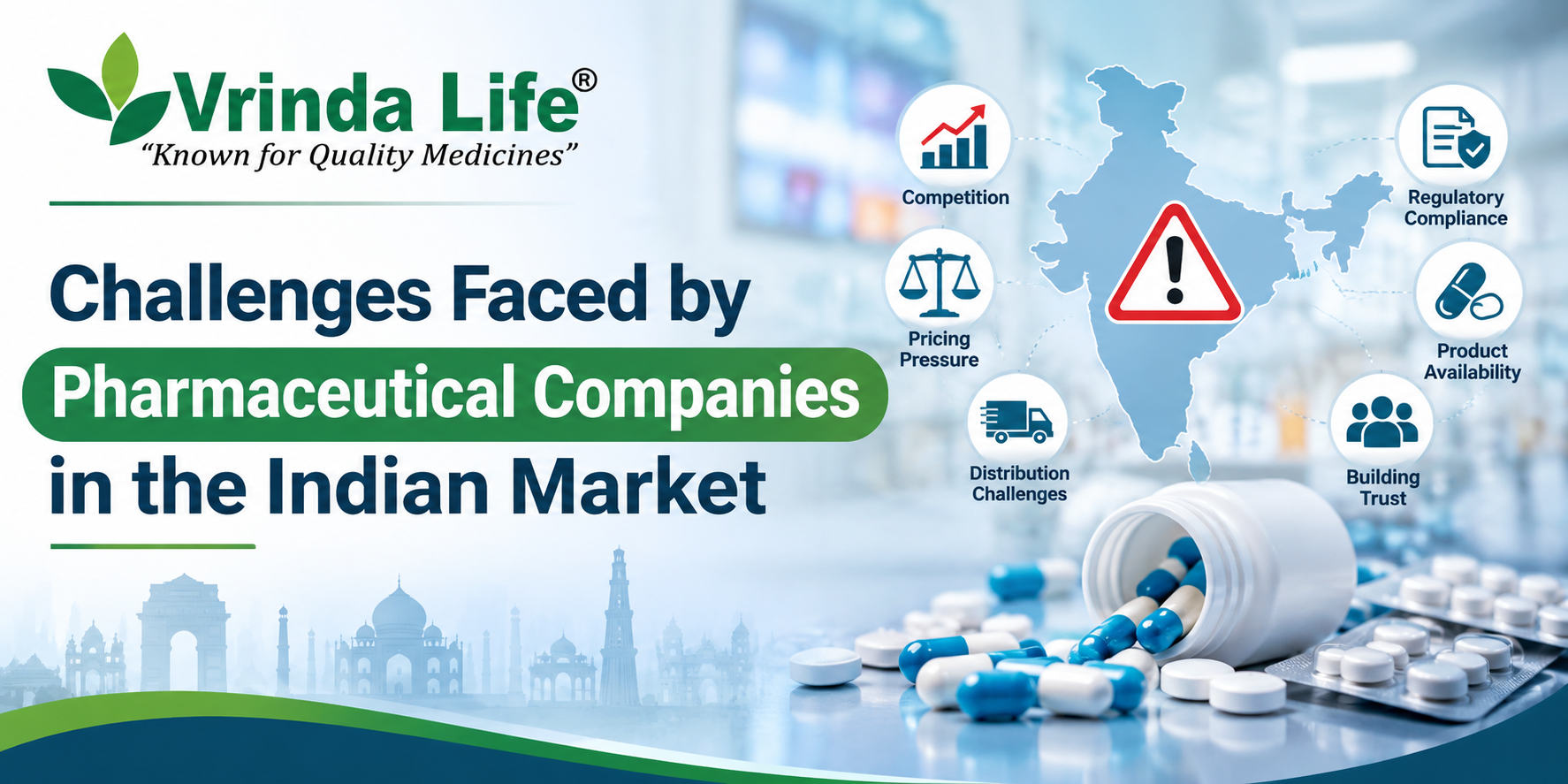
However, running a pharmaceutical business in India comes with several challenges. Increasing competition, changing customer expectations, pricing pressure, product availability, regulatory requirements, and distribution problems can make business operations difficult.
For pharmaceutical marketing companies, these challenges are particularly important because their success depends on product quality, market reach, reliable supply, and strong relationships with distributors and healthcare professionals.
People searching for pharma companies near me or comparing the biggest pharma companies often focus on product ranges and market reputation. However, understanding the difficulties these businesses face is equally important.
In this article, we will discuss the major challenges faced by pharmaceutical companies in the Indian market and explore practical ways to manage them. Vrinda Life brings you this overview to help readers understand the business realities of pharmaceutical marketing and distribution in India.
1. Increasing Competition in the Pharmaceutical Industry
Competition is one of the biggest challenges for pharmaceutical companies in India. The market has thousands of established brands and growing pharmaceutical businesses offering medicines across different therapeutic categories.
Many companies offer products with similar compositions, making it difficult for businesses to establish their own identity.
This competition is visible in several segments, including:
- General medicines
- Cardiology
- Diabetology
- Gastroenterology
- Dermatology
- Orthopaedics
- Antibiotics
- Nutraceuticals
For a new pharmaceutical marketing company, building recognition among doctors, chemists, and distributors can take considerable time.
Established companies often have stronger distribution networks, better brand recognition, and long-standing relationships with healthcare professionals.
How can companies overcome this challenge?
Companies should focus on maintaining a relevant product portfolio, providing accurate product information, and developing professional relationships with customers.
Instead of competing only on price, businesses should prioritise product quality, consistent availability, and dependable customer support.
2. Maintaining Consistent Product Availability
Product availability plays an important role in the success of pharmaceutical marketing and distribution businesses.
Distributors and retailers expect medicines to be available when they need to fulfil customer requirements. Frequent shortages can affect business relationships and create difficulties in maintaining regular orders.
Pharmaceutical companies may experience supply-related problems because of delays in product sourcing, transportation issues, inventory mismanagement, or unexpected increases in product demand.
Some common challenges include:
- Delayed order processing.
- Shortage of fast-moving medicines.
- Poor inventory planning.
- Transportation delays.
- Inconsistent product supply.
- Difficulty managing stock across different locations.
These problems can become more complicated when a company operates across several cities or states.
How can companies overcome this challenge?
Businesses should maintain proper coordination with their product suppliers, monitor inventory regularly, and understand the demand for different products.
Advance order planning and regular stock updates can help reduce shortages and improve distribution efficiency.
3. Finding Reliable Pharmaceutical Product Suppliers
Pharmaceutical marketing companies need reliable product suppliers to maintain their product portfolios and serve their customers effectively.
Choosing suitable suppliers is important because product quality, packaging, documentation, and supply consistency directly influence a company’s reputation.
Selecting a supplier only because of lower prices can create difficulties if product quality or delivery commitments are not maintained.
Some important factors to consider include:
- Applicable licences and certifications.
- Product quality documentation.
- Product consistency.
- Packaging and labelling standards.
- Product availability.
- Supply timelines.
- Commercial terms and communication.
How can companies overcome this challenge?
Companies should carefully evaluate product suppliers before entering into business arrangements.
Checking relevant licences, reviewing quality documentation, understanding supply timelines, and maintaining clear agreements can help reduce business risks.
4. Managing Product Pricing and Profit Margins
Pricing is another major concern for pharmaceutical businesses in India.
Customers are often conscious of medicine prices, and companies must offer competitive products while maintaining sustainable business operations.
Pharmaceutical marketing companies also need to consider product procurement expenses, transportation costs, distributor margins, sales expenses, and other operating costs.
Government price controls create additional considerations for medicines covered under the Drugs (Prices Control) Order.
Some common pricing challenges include:
- Increasing product procurement costs.
- Competition from established brands.
- Limited pricing flexibility for regulated medicines.
- Distributor and retailer margin expectations.
- Increasing transportation and operational expenses.
Maintaining profitability without compromising product quality can be difficult, especially for smaller businesses.
How can companies overcome this challenge?
Businesses should develop practical pricing strategies after considering market demand, applicable price regulations, operating expenses, and distribution margins.
Careful cost management and proper product selection can help maintain financial stability.
5. Building Trust Among Doctors and Healthcare Professionals
Trust is extremely important in the pharmaceutical industry because medicines are directly connected with patient health.
Pharmaceutical marketing companies need to communicate product information accurately and professionally.
However, gaining recognition among doctors and healthcare professionals is not always easy, particularly for new businesses competing with established pharmaceutical brands.
Healthcare professionals expect relevant product information, knowledgeable representatives, and responsible communication.
Some common difficulties include:
- Limited brand recognition.
- Strong competition from established companies.
- Insufficient product knowledge.
- Irregular professional communication.
- Unverified promotional claims.
How can companies overcome this challenge?
Companies should train their sales representatives and ensure that they understand the products they represent.
Providing accurate product literature and maintaining professional relationships can help businesses develop credibility over time.
All promotional communication should follow applicable ethical and regulatory requirements.
6. Developing an Effective Distribution Network
India has a geographically diverse market, and pharmaceutical distribution requirements differ between metropolitan cities, smaller towns, and rural areas.
Establishing a reliable distribution network is therefore a major challenge for pharmaceutical companies.
Businesses need to coordinate with stockists, wholesalers, medical distributors, and retail pharmacies to ensure that products reach the intended markets.
Common distribution problems include:
- Finding dependable distributors.
- Managing multiple business partners.
- Delayed payments.
- Transportation difficulties.
- Poor coordination between suppliers and distributors.
- Maintaining sufficient stock.
- Expanding into new geographical areas.
Without proper distribution planning, even companies with a good product range may struggle to reach their target customers.
How can companies overcome this challenge?
Businesses should select distribution partners based on their local market knowledge, experience, and ability to manage orders.
Regular communication, transparent payment policies, and proper order management can improve distribution operations.
7. Increasing Pharmaceutical Marketing Expenses
Marketing is an important part of pharmaceutical business development.
Companies need to introduce their products, create brand awareness, communicate with healthcare professionals, and maintain relationships with distributors.
However, marketing activities require financial investment, which can be challenging for smaller businesses.
Some common marketing expenses include:
- Sales representative salaries.
- Product information materials.
- Promotional stationery.
- Travel and field visits.
- Digital marketing.
- Customer communication.
- Business development activities.
Competing with the biggest pharma companies can be difficult when smaller businesses have limited marketing budgets.
How can companies overcome this challenge?
Companies should prepare marketing plans according to their business requirements and available resources.
Combining professional field activities with digital communication can help businesses reach their target audiences more effectively.
The focus should remain on accurate product information and ethical promotional practices rather than unnecessary advertising expenses.
8. Understanding Regulatory Requirements
The Indian pharmaceutical industry operates under strict regulatory requirements because medicines must meet established standards of quality, safety, and distribution.
Pharmaceutical marketing companies also need to understand the legal requirements applicable to their business activities.
Depending on their operations, relevant requirements may include:
- Applicable drug sale and distribution licences.
- Product approval documentation.
- Labelling and packaging requirements.
- Drugs and Cosmetics Act and Rules.
- Applicable drug pricing regulations.
- Ethical pharmaceutical marketing practices.
- Proper purchase and sales records.
Failure to follow applicable requirements can result in legal complications, financial losses, and damage to business reputation.
How can companies overcome this challenge?
Businesses should maintain proper documentation, verify relevant licences, understand their legal responsibilities, and seek professional regulatory guidance when required.
They should also ensure that all product-related information is accurate and supported by appropriate documentation.
9. Managing Product Expiry and Inventory
Inventory management is one of the most important operational activities for pharmaceutical marketing companies.
Medicines have specific shelf lives, and businesses must monitor their stock carefully to avoid expiry-related losses.
Poor inventory management can result in excess stock, product shortages, and unnecessary financial pressure.
For companies dealing with multiple product categories, monitoring batch numbers and expiry dates can become particularly challenging.
Some common inventory problems include:
- Overstocking slow-moving products.
- Shortages of high-demand medicines.
- Poor stock rotation.
- Inadequate expiry monitoring.
- Incorrect inventory records.
- Financial losses due to expired products.
How can companies overcome this challenge?
Businesses should maintain batch-wise inventory records and regularly monitor product expiry dates.
Following the First Expiry First Out (FEFO) method helps ensure that products with earlier expiry dates are prioritised for distribution.
Using digital inventory management systems can also improve accuracy and reduce manual errors.
10. Finding the Right Pharmaceutical Business Partners
Choosing suitable business partners is important for companies involved in pharmaceutical marketing and distribution.
A business relationship should be based on clear expectations, transparent communication, and reliable operations.
For entrepreneurs looking to enter the pharmaceutical sector, selecting a suitable company requires more than comparing product prices.
Important factors include:
- Product portfolio.
- Product quality standards.
- Applicable documentation.
- Pricing and business terms.
- Product availability.
- Marketing support.
- Distribution arrangements.
- Customer service.
People searching for pharma companies near me may find several businesses operating in their region. However, selecting a company simply because it is nearby may not always be the best decision.
It is important to understand its business practices, product range, market reputation, and ability to provide consistent support.
How can companies overcome this challenge?
Businesses should communicate their expectations clearly before entering into a partnership.
Both parties should understand the commercial terms, responsibilities, product supply arrangements, and applicable business requirements.
11. Adapting to Digital Changes in the Pharmaceutical Market
Digital technology is changing how pharmaceutical companies manage their business operations.
Today, companies increasingly use digital platforms for product information, customer communication, order management, and marketing.
However, adopting new technology can be difficult for businesses that depend heavily on traditional processes.
Some important areas of digital development include:
- Online product catalogues.
- Digital inventory management.
- Customer relationship management systems.
- Online order tracking.
- Business websites.
- Digital marketing.
- Electronic documentation.
Without suitable digital systems, maintaining accurate records and coordinating with multiple distributors can become time-consuming.
How can companies overcome this challenge?
Businesses should gradually adopt digital tools according to their operational requirements.
A professional website, organised product information, and digital customer records can help improve business communication and efficiency.
12. Understanding Changing Market Requirements
Customer expectations in the pharmaceutical industry continue to change.
Doctors, chemists, distributors, and retailers increasingly expect reliable product information, timely responses, competitive pricing, and consistent product availability.
Pharmaceutical companies need to understand these expectations to maintain long-term business relationships.
For example, distributors may prefer companies that communicate clearly about order status and stock availability. Similarly, pharmacists expect accurate information about product composition, packaging, and expiry dates.
How can companies overcome this challenge?
Companies should regularly communicate with their customers, understand local market demand, and take feedback seriously.
Responding to queries on time and maintaining transparent business practices can help improve customer satisfaction.
Future of Pharmaceutical Marketing Companies in India
The Indian pharmaceutical industry is expected to continue developing as healthcare awareness increases and access to medical services expands.
Growing demand for medicines related to chronic conditions, increasing healthcare expenditure, and improvements in distribution infrastructure are creating opportunities for pharmaceutical marketing and distribution businesses.
At the same time, companies will need to adapt to changing regulations, increasing competition, digitalisation, and higher customer expectations.
Businesses that focus on reliable product sourcing, quality standards, professional marketing, and efficient distribution will be better positioned to respond to market changes.
For entrepreneurs, the pharmaceutical sector can offer opportunities, but proper market research and business planning remain essential.
Conclusion
The Indian pharmaceutical market offers significant business opportunities, but operating successfully requires careful planning and consistent effort.
Pharmaceutical marketing companies face several challenges, including intense competition, product availability, pricing pressure, regulatory compliance, distribution management, inventory control, and maintaining relationships with healthcare professionals.
Addressing these challenges requires more than an attractive product range. Companies must focus on reliable business relationships, responsible marketing, accurate product information, and efficient operations.
For individuals exploring the pharmaceutical sector, understanding these practical difficulties can help them make informed decisions and develop realistic business expectations.
Ultimately, long-term success in the pharmaceutical industry depends on maintaining trust, understanding market requirements, and following responsible business practices. Vrinda Life encourages businesses and aspiring entrepreneurs to keep these fundamentals in mind when evaluating opportunities in the pharmaceutical sector.
Frequently Asked Questions (FAQs)
1. What are the major challenges faced by pharmaceutical companies in India?
The major challenges include increasing competition, product availability, pricing pressure, regulatory compliance, distribution difficulties, marketing expenses, inventory management, and maintaining customer relationships.
2. What challenges do pharmaceutical marketing companies face?
Pharmaceutical marketing companies commonly face difficulties related to brand awareness, product sourcing, supply consistency, distributor management, customer communication, marketing expenses, and regulatory requirements.
3. How can I find reliable pharma companies near me?
You can search online, visit official company websites, and consult local pharmaceutical distributors. Before selecting a company, check its product portfolio, business reputation, applicable licences, product quality standards, and commercial terms.
4. What should I consider before choosing a pharmaceutical business partner?
Consider product quality, product availability, pricing, business terms, applicable documentation, distribution arrangements, and customer support. It is also important to understand the company’s business model before entering into an agreement.
5. Why is product availability important in the pharmaceutical industry?
Regular product availability helps distributors and retailers fulfil customer requirements. Frequent shortages can affect business relationships, customer satisfaction, and overall sales.
6. How can pharmaceutical companies compete with established brands?
Companies can compete by maintaining product quality, offering relevant product ranges, developing professional relationships, providing reliable customer service, and improving distribution efficiency.
7. Why is inventory management important for pharmaceutical businesses?
Proper inventory management helps prevent stock shortages, reduce expiry-related losses, monitor product movement, and maintain better control over business expenses.
Related posts